IBPC Dubai, Indian Consulate and DIAC Call for Stronger Indo-UAE Collaboration on AI-Ready, Skills-Based Education in DubaiFocus on lifelong learning and innovation as drivers of future workforce development
Dubai, United Arab Emirates
Education leaders, policymakers, industry stakeholders and members of the Indian business community in Dubai have called for deeper industry-academia integration, accelerated AI readiness, and stronger lifelong learning pathways as central pillars of Dubai’s future education and workforce strategy.
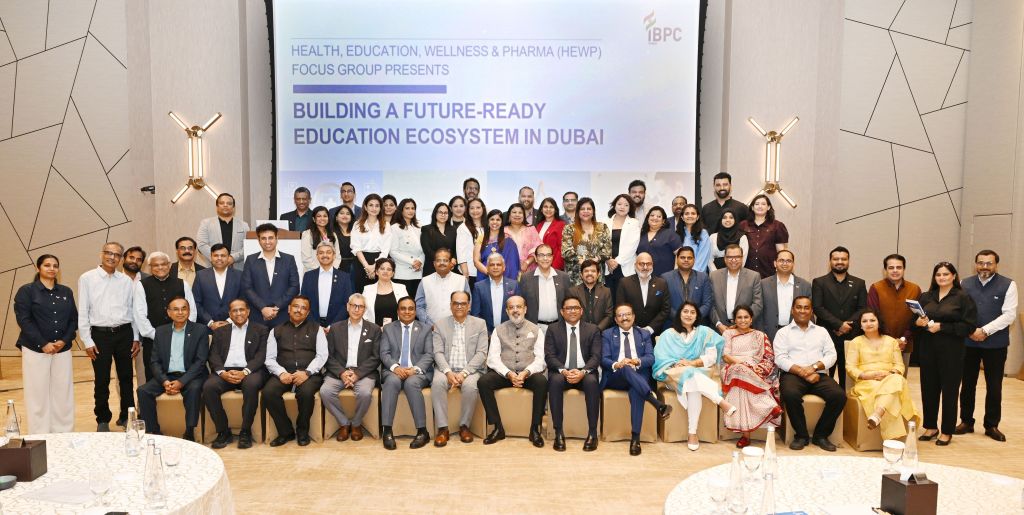
The discussions, held under the IBPC Dubai HEWP Focus Group Business Breakfast on “Building a Future-Ready Education Ecosystem in Dubai”, underscored a shift toward skills-based, innovation-led education models aligned with Dubai’s long-term economic transformation agenda.
Opening the dialogue, Mr. Sreekumar Brahamanadan, Convener, HEWP Focus Group, positioned education as a core economic driver of Dubai’s next phase of growth.
“Dubai is no longer viewed simply as a city; it has evolved into a global hub for education, innovation, business and talent development. The education sector is becoming a strategic pillar of Dubai’s knowledge economy and a key enabler of the Dubai Economic Agenda (D33),” he said.
He highlighted that Dubai’s higher education ecosystem now serves over 42,000 students, with 35% international representation, across 37 international branch campuses, drawing learners from more than 170 nationalities, and expanding at approximately 20% annually.
He further stressed the growing strategic value of education-sector engagement for business and industry, adding, “Businesses that engage with the education sector today are not only investing in talent development; they are helping shape Dubai’s next phase of economic growth, innovation and global competitiveness.”
Addressing the gathering, Shri Yatin Patel, Deputy Consul General of India in Dubai and the Northern Emirates, highlighted the deepening India-UAE education partnership, citing the establishment of the IIM-Ahmedabad Dubai campus as a milestone in bilateral academic cooperation and acknowledging the role of platforms such as IBPC Dubai in enabling cross-sector engagement.
A key strategic perspective came from Mr. Chindu Mohsin, Director of Business Development, Dubai International Academic City (DIAC), who outlined structural shifts in Dubai’s higher education landscape and labour market alignment.
He revealed that Dubai’s education ecosystem currently supports 17 curricula, with approximately 42% of university students of Indian origin, reflecting the strong role of the Indian diaspora in shaping the sector.
“The future of work is changing rapidly. While technology and artificial intelligence will continue to transform industries, human skills such as creativity, adaptability, critical thinking and collaboration will remain essential. The institutions that succeed will be those that can combine technological advancement with human-centred learning,” he said.
He also confirmed continued expansion with the entry of new international universities from China, the United Kingdom and Egypt, alongside rising demand in vocational education, pathway colleges, corporate training, HR development, language learning and professional education, signalling strong growth in lifelong learning markets.
The discussion outcomes reflected growing consensus that AI integration, employability-focused learning, internships, and industry-led curriculum design will define the next phase of education reform in the UAE. Participants also emphasised the need to strengthen applied learning through structured industry exposure and accelerate EdTech-driven innovation, including ecosystem support platforms such as In5.
A proposal for a Quality Management Institute was also discussed as a potential mechanism to strengthen standards, capability development, and cross-institutional benchmarking across the education sector.
Speaking at the occasion, Mr. Sunil Sinha, Vice Chairperson of IBPC Dubai, highlighted about the organisational growth and inclusivity, noting that female membership at IBPC has increased over 150% in last one year, reflecting broader participation in the business and professional ecosystem.
Dr. Sahitya Chaturvedi, Secretary General, IBPC Dubai, shared updates on upcoming initiatives of IBPC Dubai for the month of June.
“The discussions reinforced a clear directional shift – Dubai’s education ecosystem is increasingly being shaped by skills demand, AI-driven transformation, and industry participation, positioning collaboration between academia, government and business as central to sustaining the emirate’s competitiveness as a global knowledge hub,” concluded Dr. Brahamanadan.
.
 UAE News 24/7