On the Sidelines of the Emirates Agriculture Conference and Exhibition 2026
The Second National Agricultural Extension Forum Kicks Off to Support and Empower Farmers
- HE Marwan Al Zaabi: The agricultural extension system is a strategic enabler of sustainable agriculture
Al Ain, 24 April 2026: The Second National Agricultural Extension Forum commenced on the sidelines of the second Emirates Agriculture Conference and Exhibition being held in Al Ain, until 26 April 2026.
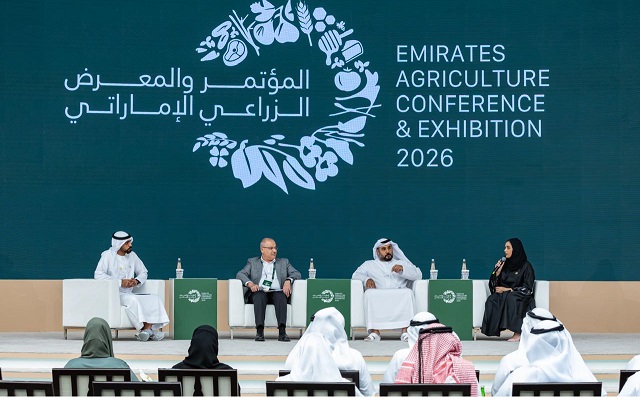
The Forum supports the core objectives of the conference and exhibition, providing comprehensive support to Emirati farmers and equipping them with the latest knowledge and technologies to boost productivity in a sustainable way. It aligns with the overarching vision of the Ministry of Climate Change and Environment (MOCCAE) that Emirati farmers play a fundamental role in driving sustainable local production.
The Forum featured targeted discussions featuring experts, officials, and agricultural specialists from across the nation. The sessions offered a platform to exchange expertise, share successful practices and identify key challenges facing the sector.
Agricultural Extension as a Strategic Service for Addressing Challenges
His Excellency Marwan Abdullah Al Zaabi, Assistant Undersecretary for the Regions Sector at MOCCAE, said that the agricultural extension system is a strategic enabler of sustainability of the sector. HE Al Zaabi called it a knowledge resource that bridges the UAE’s vision and on-the-ground farming practices. He explained that the primary role of the extension forum is to enable Emirati farmers to adopt leading international practices and strengthening their ability to anticipate and manage challenges such as climate fluctuations and agricultural pests. This supports local production while maintaining high standards of quality and competitiveness.
His Excellency explained that the Ministry’s vision for the next phase is founded on three strategic pillars. The first pillar is the comprehensive digital transformation of extension services, aimed at reaching every farmer through smart platforms that provide accurate, real-time data. The second pillar focuses on improving water and environmental efficiency through precision agriculture technologies that conserve resources and reduce the carbon footprint. The third pillar emphasises stronger partnerships and farmer empowerment, recognising Emirati farmers as central to the success of national food security. To support Emirati farmers the Ministry offers new investment opportunities to position agriculture as a sustainable profession for future generations.
Agricultural Extension: A Strategic Service with Ambitious Goals
The Ministry of Climate Change and Environment places strong emphasis on the agricultural extension system, viewing it as a key strategic service and a direct link between national priorities and on-the-ground farming practices. The Ministry aims to achieve several objectives by developing agricultural extension, primarily supporting Emirati farmers in adopting leading international practices and smart technologies to improve production efficiency and optimise water use.
His Excellency Rashid Mohammed Al Shariqi, Member of the Board of Directors of the National Agriculture Centre, said that agricultural extension is the cornerstone and principal driver of efforts to empower Emirati farmers. He described it as a significant link that translates the nation’s aspirations into sustainable, day-to-day practices on the ground. He explained that agricultural extension in the UAE has undergone a fundamental transformation, evolving from traditional approaches into an integrated model grounded in scientific research and data analysis. This transformation seeks to align national farms with the UAE’s vision of increasing local production and developing them into smart production units capable of addressing environmental challenges proactively and efficiently.
His Excellency noted that the agricultural extension officer’s role has transformed from mere information transfer into that of a digitally enabled facilitator and strategic guide, actively supporting farmers in adopting AI-powered precision agriculture techniques.
HE Al Shariqi further emphasised that positioning local produce on globally competitive platforms begins with empowering Emirati farmers with modern knowledge tools, enabling them to produce in line with the highest international quality standards. This, in turn, safeguards the sustainability of resources for future generations and strengthens the standing of national crops in international markets.
Harnessing Artificial Intelligence to Enhance Productivity Efficiency
The Forum’s first session, titled Harnessing Artificial Intelligence to Achieve Sustainability and Productivity Efficiency, focused on the transformative role of advanced technologies in reshaping the agricultural sector. Moderated by Abdullah Saleh Al Hashemi from the Ministry of Climate Change and Environment, the session brought together Eng. Razan Fahad Al Hammadi, Director of Green Development at the Sharjah Agriculture and Livestock Department; Eng. Mohammed Al Dhanhani, Director of Agricultural Development and Health at MOCCAE; and Dr Khalil Ammar from the International Centre for Biosaline Agriculture. The panellists outlined the UAE’s vision to turn environmental and climate challenges into promising development opportunities by leveraging data and artificial intelligence as essential tools for resource management and the advancement of national farms.
The session explored pathways to enhance crop productivity and implement integrated management approaches to ensure sector sustainability, through the optimal deployment of AI applications in monitoring and forecasting. This enables precise, data-driven agricultural decisions that maximise yields while minimising the depletion of water resources. At its core, the session aimed to establish a practical roadmap for equipping farmers and extension officers with precision agriculture tools, ensuring that local produce meets the highest levels of quality and global competitiveness. This aligns with national objectives to accelerate progress, achieve self-sufficiency, and build a resilient and innovative food security system. Participants also underscored the importance of accurate data when utilising AI applications, as well as the need for extension officers to adopt appropriate communication approaches with farmers and to simplify complex information in ways that address on-the-ground needs.
Adopting Good Agricultural Practices and Enhancing Product Competitiveness
In the same context, the second session highlighted the theme of “Adopting Good Agricultural Practices.” Moderated by the National Agriculture Centre, with the participation of three agricultural officials and specialists from across the UAE, the session examined mechanisms for transforming traditional farms into models aligned with the highest standards. This supports national efforts to enhance the quality and safety of local produce, while establishing a robust foundation to help farmers adopt and implement internationally recognised certification standards, thereby elevating the competitiveness of Emirati crops.
Sustaining Livestock Resources and Improving Production Efficiency
The third and final session, moderated by the Ministry of Climate Change and Environment with participation from national agricultural officials, was held under the title “Enhancing Livestock Production Efficiency to Address Changes and Ensure the Sustainability of the Livestock Sector.” Discussions focused on effective adaptation strategies and innovative solutions to improve the efficiency of the livestock sector, ensuring its sustainability and growth amid evolving environmental and climate conditions. Participants emphasised the complementary relationship between plant and animal production in achieving a comprehensive and integrated national food security system.
The second National Agricultural Extension Forum concluded with the adoption of an actionable roadmap that translates insights and innovations from discussion halls into tangible outcomes in fields and farms. These practical steps aim to transform the Forum’s outputs into meaningful empowerment programmes that support Emirati farmers and accelerate the adoption of smart agriculture technologies, ensuring that national produce remains the highest-quality and most competitive choice within a sustainable food security ecosystem.
-END-
 UAE News 24/7