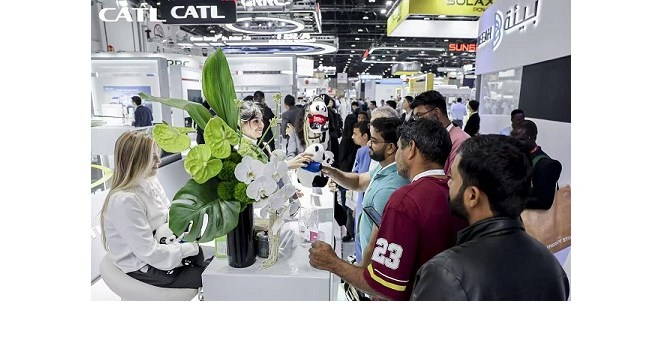
CATL used the World Future Energy Summit 2026 to highlight how energy storage design, land use and project economics are shaping large-scale renewable deployments across the Middle East.
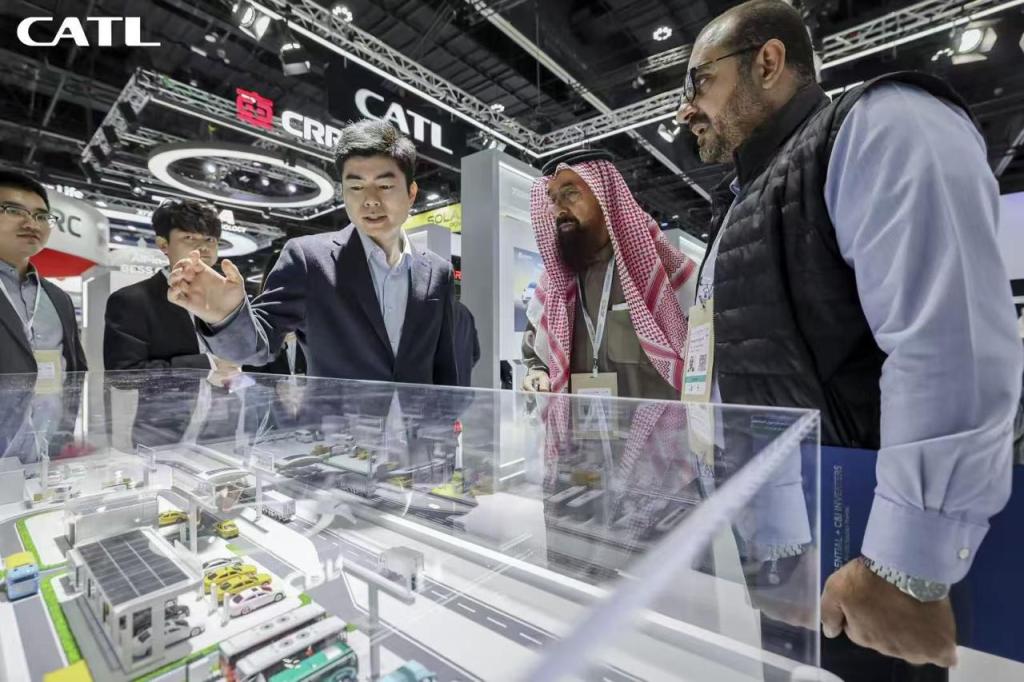
As governments and utilities in the region accelerate investment in grid resilience and clean energy infrastructure, attention is increasingly turning to the practical realities of deploying energy storage at scale. These include land availability, transportation constraints and total project cost, areas that CATL addressed during its participation at the summit.
A central focus of the company’s presentation was its TENER Stack energy storage system, which has been developed to support large-scale renewable integration while improving land efficiency and deployment speed. The stacked design is intended to reduce footprint and simplify logistics, particularly in space-constrained or urban environments.
Speaking at the event, Kui Weng, CEO of CATL Energy Storage Solutions in the Middle East, noted that technology cost represents only a portion of overall investment considerations.
“Investment requirements depend on several factors, including equipment costs, transportation, land, installation, EPC costs and maintenance,” Weng said. “From a technology perspective, costs typically represent around 20% of the total investment, with EPC costs being a major component.”
Designing for land efficiency and logistics
According to CATL, the TENER Stack system addresses several challenges commonly encountered in large-scale projects. Its stacked configuration reduces land usage by approximately 35%, while dividing the system into two transportable sections helps avoid heavy cargo classification and reduces the need for specialised transport equipment.
“This approach lowers transportation complexity and cost,” Weng explained. “By keeping each section within standard weight limits, projects can move more quickly through permitting and logistics stages.”
The integrated architecture also streamlines on-site installation, reducing wiring complexity and shortening construction timelines. CATL estimates that installation time and costs can be reduced by around 20%, supporting faster project delivery.
Supporting deployment in extreme environments
Designed to operate in temperatures of up to 55°C, the TENER Stack system has been tailored for the Middle East’s operating conditions. Its reduced footprint and modular design make it suitable for urban, coastal and land-constrained sites where traditional layouts may be less practical.
Through its participation at WFES 2026, CATL positioned itself as a long-term partner in the region’s energy transition, focusing on solutions that address real-world deployment challenges rather than technology performance alone.
As energy storage moves from pilot projects to core infrastructure across the Middle East, developers are increasingly prioritising scalability, reliability and cost efficiency. CATL’s presentation at the summit reflects this shift toward practical design strategies that support the region’s expanding renewable energy ambitions.
 UAE News 24/7