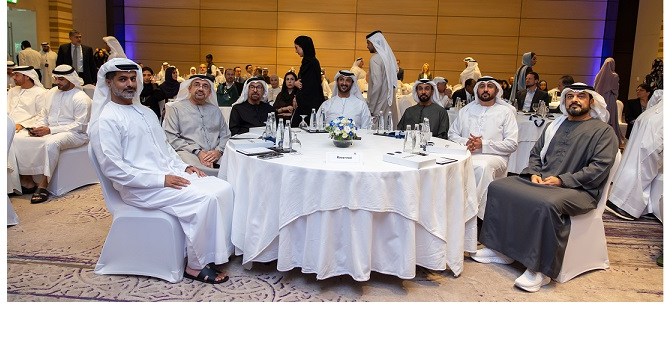
Abu Dhabi, United Arab Emirates, 08 January 2026 – In line with national efforts to strengthen the sustainability of family-owned enterprises and reinforce their contribution to the national economy, Abu Dhabi hosted the “Beyond Legacy: Sustaining Family Businesses in the UAE” seminar. The event was organised by Habib Al Mulla and Partners, in collaboration with the Ministry of Economy and Tourism and the Abu Dhabi Family Business Council, an entity of the Abu Dhabi Chamber of Commerce and Industry. The seminar aimed to highlight the critical role of institutional governance and long-term strategic planning in ensuring effective and sustainable intergenerational succession within family businesses.
The seminar convened with the participation of H.E. Abdulla bin Touq Al Marri, Minister of Economy and Tourism, alongside H.E. Shamis Ali Khalfan Al Dhaheri, Second Vice Chairman and Managing Director of the Abu Dhabi Chamber; H.E. Khaled Abdul Karim Al Fahim, Chairman of the Abu Dhabi Family Business Council and Board Member of the Abu Dhabi Chamber ; and H.E. Masood Rahma Al Masood, Vice Chairman of the Abu Dhabi Family Business Council and Treasurer of the Board of Directors of the Abu Dhabi Chamber. The seminar was also attended by Ms. Alia Habib Al Mulla, Head of Commercial Disputes at Habib Al Mulla & Partners, in addition to a select group of family business leaders and legal and economic experts.
The seminar builds on the success of the inaugural “Beyond Legacy” edition held in Dubai and organized by Habib Al Mulla and Partners Firm, marking a new milestone within a series of ongoing national efforts aimed at strengthening institutional governance culture, supporting the sustainability of family businesses, and enabling them to continue playing a pivotal role in economic diversification and competitiveness, in line with the UAE’s long-term economic vision.
The programme featured a keynote address by H.E. Abdulla bin Touq Al Marri, Minister of Economy and Tourism, who highlighted the role of supportive economic policies and legislative frameworks in enhancing the sustainability of family businesses and advancing the objectives of UAE Vision 2031.
The seminar also included two key panel discussions. The first focused on the legal frameworks and governance structures governing family businesses, while the second addressed practical experiences, success stories, and challenges associated with the implementation of governance models, the transition from traditional to institutional management, the assurance of generational succession, and the development of family constitutions and charters.
H.E. Abdulla Bin Touq Al Marri affirmed that the UAE views family businesses as a key driver for bolstering national economic growth and sustainability, supporting the nation’s transition towards a knowledge-based and innovation-driven future economy. H.E. also noted that the Ministry, in collaboration with relevant government partners and family businesses, has enacted a comprehensive legislative framework—specifically Federal Decree-Law No. 37 of 2022 concerning Family Companies—to govern these entities and ensure their intergenerational continuity.
Furthermore, H.E. Bin Touq stated that the Ministry has issued four ministerial resolutions establishing the Unified Registry for Family Companies, which currently includes over 18 companies. These resolutions also regulate the Family Charter, share buyback mechanisms, and the issuance of multiple share classes, contributing to fostering a sustainable legislative ecosystem that ensures the growth of family businesses and secures their leadership on both regional and global scales.
H.E. Shamis Ali Khalfan Al Dhaheri, Second Vice Chairman and Managing Director of the Abu Dhabi Chamber, affirmed that the Chamber continues to play a central role in supporting the sustainability of family businesses. He noted that the adoption of effective governance models enhances investor confidence, strengthens private sector competitiveness, and aligns with Abu Dhabi’s vision of a knowledge-based and innovation-driven economy.
H.E. Khalid Abdul Karim Al Fahim, Chairman of the Abu Dhabi Family Business Council, said “Family-owned enterprises are fundamental partners of the economic development journey of the Emirate of Abu Dhabi and the United Arab Emirates. Operating under the umbrella of the Abu Dhabi Chamber of Commerce and Industry, the Abu Dhabi Family Business Council is committed to advancing best practices in governance, strengthening strategic and succession planning, and supporting effective intergenerational transition, thereby ensuring the long-term sustainability of family businesses and safeguarding their enduring economic and social legacy.”
H.E. Masood Rahma Al Masood, Vice Chairman of the Abu Dhabi Family Business Council, and Treasurer of the Board of Directors of the Abu Dhabi Chamber stated that “Investing in the next generation of family business leaders constitutes a fundamental pillar of sustainability within this ecosystem. The Council is committed to providing knowledge-sharing and dialogue platforms that facilitate the transfer of expertise and raise awareness of the importance of governance and early institutional planning.”
Ms. Alia Habib Al Mulla, Head of Commercial Disputes at Habib Al Mulla and Partners, emphasised that the seminar represents a significant step forward in establishing a comprehensive national dialogue on the future of family businesses in the United Arab Emirates. She noted that the sustainability of a family legacy is not a matter of chance, but the outcome of a clear strategic vision, a cohesive and well-defined family charter, and early institutional planning that ensures balance and alignment across successive generations. She added: “We are proud to collaborate with the Ministry of Economy, the Abu Dhabi Chamber, and the Abu Dhabi Family Business Council on an initiative that translates the wise leadership’s vision for a diversified and sustainable economy.”
The seminar witnessed a high level of engagement from participants, who underscored the importance of adopting robust governance frameworks, as well as effectively implementing legislation relevant to family-owned enterprises. Such measures, they noted, are essential to strengthening long-term sustainability and enhancing the capacity of family businesses to expand, evolve, and grow across successive generations.
The “Beyond Legacy” series is set to continue its forthcoming editions across several Emirates throughout 2026, as part of a broader national initiative aimed at advancing institutional awareness, embedding a strong culture of governance, and further reinforcing the sustainability and resilience of family businesses operating in the United Arab Emirates.
– End –
 UAE News 24/7