The Egyptian actor spoke about bringing Tolkien’s classic tale to life in Arabic and about how storytelling through sound can awaken imagination across worlds and languages
Sharjah, November 7, 2025
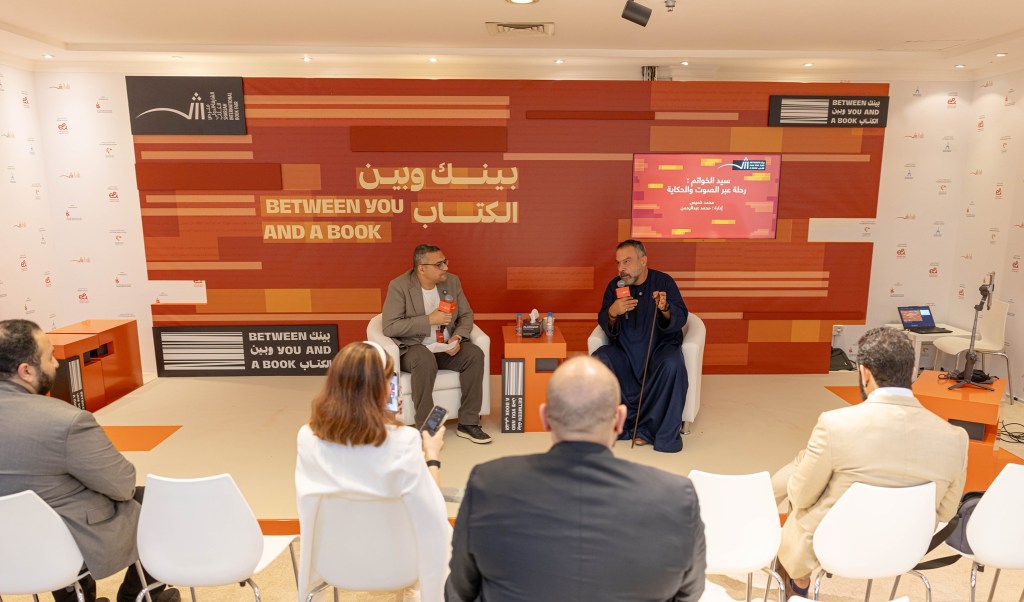
At the Sharjah International Book Fair (SIBF 2025), which is running until November 16 at Expo Centre Sharjah, die-hard fans of J.R.R. Tolkien’s timeless tale assembled for a session titled “The Lord of the Rings in Arabic: A Journey Through Sound & Storytelling.” Egyptian actor Mohamed Khamis, who narrated the Arabic audiobook edition of the classic, and discussed the experience of adapting the renowned literary work into an audiobook. Journalist Mohamed Abdel Rahman moderated the discussion.
For Khamis, voicing The Lord of the Rings was an act of world-building through sound. He described the audiobook as an entirely new medium of storytelling: “It’s not a serial or a film; it’s something in between, an artistic space where voice becomes the author.”
The actor said that the project was a blend of poetry and performance, drawing parallels with early Arabic oral traditions. “Our heritage is full of narrative poetry where the storyteller was the soul of the story. I wanted to bring that essence into Tolkien’s world,” he said.
Khamis said that audiobooks demand mastery of tone and rhythm to distinguish each character, whereas in film or theatre, actors rely on visual cues. He explained that his process began with creating a psychological and emotional map for each persona, from Frodo’s selflessness to Gandalf’s wisdom.
He said: “In the audiobook, I’m not imposing my imagination on the listener; I’m guiding them to find theirs. It’s about giving each character space to live through sound.”
He also discussed the practical challenges of long recording hours and multiple takes, among others. “When you act for the microphone, you need to listen critically, adjust, and trust your instincts but also rely on your team for honest feedback,” he shared.
A key element of the project was the Arabic translation, which required a delicate balance between being faithful to Tolkien’s world and the fluidity of Arabic expression. Khamis emphasised: “Translation isn’t just about words, it’s about reimagining ideas. Arabic has its own rhythm and musicality, and when done well, it amplifies the drama instead of diluting it.”
He emphasised that Tolkien’s universe, while fantastical, remains profoundly human: “Even if the characters are elves or hobbits, their struggles and themes are human — courage, loss, friendship, temptation. That’s what makes the story timeless.”
The Arabic Lord of the Rings audiobook marks a milestone in the growing field of Arabic audio literature. Khamis said that audiobooks, as a medium, can connect classical storytelling with modern platforms, introducing younger listeners to global literary masterpieces. He concluded: “Storytelling in Arabic still has vast worlds to explore and many voices yet to be heard.”
-ENDS-
 UAE News 24/7